
In short
The key takeaways from this blog:
- AI Mode is now mainstream. A year after its UK launch, more than a billion people use AI Mode every month, and its use keeps growing fast.
- People search in full questions. AI Mode searches are three times longer than traditional ones, so your content needs to answer customer questions in-depth.
- Fewer searches end in a click. Most UK searches now end on Google's results page, and AI Mode sends even fewer visits to websites.
- Being named in the answer still counts. When AI Mode cites your business, you earn recognition and trust. Cited brands tend to win more clicks, too.
- There's no secret AI playbook. Google's guidance confirms that getting seen in AI search is still SEO, built on useful content and solid fundamentals.
- Measure more than traffic. Track AI impressions in Search Console, branded searches and AI referrals in GA4, and where your enquiries come from.
- Consistency earns citations. QBD Pulse delivers expert, SEO-led content every month, and Atlas shows you how your search visibility is building.
A year ago, AI Mode arrived in the UK.
Today, more than a billion people use it every month.
That's a big shift in a short space of time. And it's changing what it means to be found online.
When we wrote What does AI Mode mean for your business? last summer, AI Mode was brand new. Now it's one of the main ways people search. So, in this blog, we'll look at what's changed over the past year, why being seen in AI responses matters as much as the click, and what earns your business a place in those answers.
What is AI Mode?
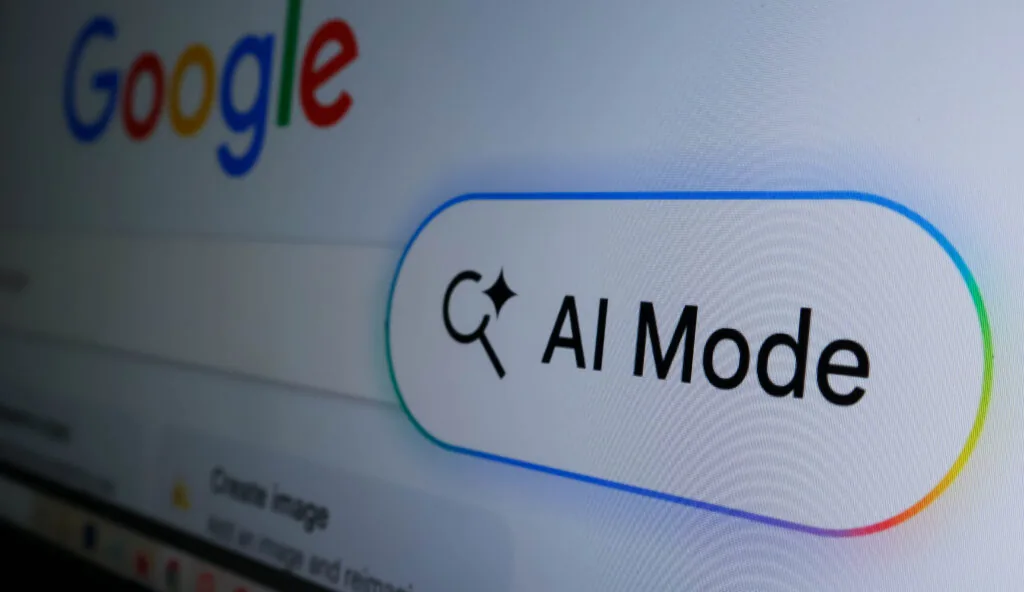
AI Mode is Google's conversational search experience. Instead of a list of links, it gives searchers a full, AI-written answer to their question, with links to the sources it used. They can then ask follow-up questions, just like a conversation.
For your business, that if AI Mode doesn't trust your content enough to use it, you're not part of the answer.
What's changed since AI Mode launched?
AI Mode launched in the UK in July 2025. At the time, it sat in a separate tab and felt like an experiment.
It doesn't feel like an experiment anymore.
In May 2026, Google confirmed that AI Mode had passed a billion monthly users worldwide, with queries more than doubling every quarter since launch. People are also searching differently. The average AI Mode search is now three times longer than a traditional Google search, and planning-related questions have grown 80% faster than AI Mode searches overall in the past six months.
That tells you a lot about how your customers now search. They're not typing 'marketing agency Worcester'. They're asking full questions, like 'which marketing agency near me can handle my social media and blogs every month?' and expecting a considered answer back.
Two other changes matter for businesses:
- Google has published official guidance. In May 2026, it released a guide to optimising for its generative AI features. Its message is simple. Getting seen in AI search is 'still SEO'. There's no secret new playbook.
- You can now measure it. Google added generative AI performance reports to Search Console in June 2026, showing how often your pages appear in AI Overviews and AI Mode. By the end of August, it had rolled out to every website.
Why being seen now matters more than being clicked
For years, the logic of search was simple. Rank highly, get the click, win the customer.
AI search has rewritten that logic.
More searches now end on Google's results page. In the first four months of 2026, 69.5% of UK Google searches ended without a click to any website. That's the highest rate of the six countries studied. In AI Mode, the pattern is even stronger. Early research from Semrush found that only six to eight per cent of AI Mode sessions led to a visit to another website.
It's easy to read those numbers and panic. We'd encourage you not to.
Here's why. When someone asks AI Mode a question and your business is named in the answer, something valuable has still happened. A potential customer has seen your name, linked to the exact problem they're trying to solve, in an answer they trust. That's the digital equivalent of a recommendation from someone they respect.
And being cited does lead to more clicks. Seer Interactive's 2026 study of 53 brands found that brands cited in Google's AI Overviews earned more than double the organic clicks per impression of brands that weren't cited. The people who do click through have usually read the answer first. They arrive better informed and further along in their decision.
So, the goal hasn't disappeared. It's moved. The question is no longer just 'are we ranking?'. It's 'are we part of the answer?'.
What gets a business cited in AI Mode?
AI Mode doesn't run one search for one question. It uses a technique called fan-out, breaking a question down into lots of smaller searches and pulling the best answer to each part into one response.
That changes how your content needs to work. We covered the detail in How AI Overviews are changing who gets found in search, but the essentials are worth repeating.
Answer questions fully
A page that mentions a topic in passing is a weak candidate. A page that answers a specific question properly is a strong one. Think about the questions your customers ask you, and make sure your website answers each of them clearly.
Show real expertise
Put a real person's name on your content, and write from what you've done (ie, your experience), not just what you've read. Google's E-E-A-T guidelines reward experience, expertise, authority and trust. AI Mode is built on the same quality system.
Make every paragraph count
Write paragraphs that make sense on their own, with the key point stated clearly near the start. If a single paragraph can be lifted into an AI answer and still be useful, you're doing it right.
Get the technical basics right
A fast, secure, mobile-friendly website that search engines can easily crawl is still essential. AI Mode can only use content Google can reach and understand.
Build trust beyond your website
Reviews, accurate business listings and genuine mentions on trusted websites all help AI systems feel confident about recommending you. That's why off-page SEO matters more now, not less.
You don't need gimmicks. Google's guidance says you can ignore llms.txt files, AI-specific rewrites of your pages and chopping your content into tiny chunks. The fundamentals are what work.
How to tell if it's working
If clicks aren't the whole story, what should you look at instead? Here the key signs to track:
- AI impressions in Search Console. The new generative AI report shows how often your pages appear in AI Overviews and AI Mode, and which pages are earning that visibility.
- Branded searches. If more people are searching for your business by name, your visibility elsewhere is paying off.
- AI referrals in GA4. Google Analytics now groups visits from AI assistants into their own channel, so you can see when tools like ChatGPT or Gemini send people your way.
- Enquiries. Ask new customers how they found you. If they say 'I asked AI and it suggested you', your content is doing its job.
While none of these signs on their own tell the full story, together, they'll give you a much clearer picture than website visits alone.
Our take
Clicks were always a stand-in for something else. What businesses really want is to be the name people think of first when they need help.
AI Mode hasn't changed that goal. It's just changed how you get there.
We've seen plenty of businesses react to AI search by chasing the latest 'AI hack' or trying to game the system. In our experience, that's wasted effort. It might work in the short term, but the businesses that are being cited consistently are the ones doing the steady work, publishing genuinely useful content, every month, written by people who know their subject well.
There's an upside to this, too. When ranking was the only goal, a bigger budget could often buy its way to the top. In AI search, quality and authority carry more weight. That gives smaller businesses with real expertise a fairer chance to be heard.
So, our advice is simple. Stop judging your SEO on website traffic alone. Start asking whether the AI answers your customers see include your business.
How can QBD help?
Earning a place in AI mode comes from showing up with helpful, expert content, consistently, over time.
That's exactly what QBD Pulse is built for. Our structured monthly marketing programme delivers SEO blogs that build your authority, alongside social posts and emails that keep your business visible. With Atlas, you can see your search visibility in plain English whenever you like, without logging into GA4 or waiting for a report.
Not sure where you stand right now? Take our free Visibility-First Strategy Audit to find out what might be holding your website back, or get in touch with our team for a chat.
Related reading
- What does AI Mode mean for your business? Our original guide to AI Mode, from its UK launch.
- How AI Overviews are changing who gets found in search A deeper look at what gets content cited in Google's AI answers.
- Human strategy in a robotic world Our five-part guide to marketing to robots and winning visibility.
About the Author

Liam Maskell
Liam Maskell is Head of Sales at QBD, where for more than seven years he’s helped businesses of every size, from early-stage startups to established brands, turn their objectives into real digital growth. Before joining QBD, he worked as a freelance graphic and web designer and went on to lead sales and marketing at a software development firm, building hands-on expertise across web design, SEO, content and paid advertising. That blend of commercial and technical know-how means he speaks both languages fluently: the goals a business owner actually cares about, and the mechanics that make them work online.